10 Break-Out Sessions
[timetable id="9" column_title="0" filter_visible="1" filter_multiple="1" event_box_time="0"]
[timetable id="9" column_title="0" filter_visible="1" filter_multiple="1" event_box_time="0"]


Trust, besides all other important roles in everyday life, has a very important function in any kind of business relationship. Economists have identified trust as a crucial factor in trade and investment decisions because it enables more efficient transactions (Güth, Ockenfels & Wendel, 1993). Trust lowers the perceived risk and thus the cost and effort of controlling every detail of an exchange. Without customer trust, no business model can be successful in the long run. Online retail is no exception. And as COVID-19 has caused yet another boost in online shopping, the factors contributing to trust in online settings deserve some attention.
Consumers have learned to shop increasingly online, and it is very likely that this experience will have long-term effects. Even after the end of the COVID-19 restrictions, online commerce will probably account for a much higher share than before in most countries.
In an article about the sharing economy, Mareike Möhlmann and Timm Teubner (2020) note that online trust needs to be built between strangers. This is an interesting phenomenon, as it seems to run against our evolutionarily-rooted reservation toward strangers. “Physical proximity, personal relations, and repeated interactions have been substituted by technology. Novel ways extend the formation of trust into digital environments, successfully mitigating perceptions of ‘stranger danger’.”
There is plenty of advice on strategy and measures for gaining trust as a prerequisite to success in e-business. Reviews and ratings by other customers play a central role in dispelling concerns and support the choice of products and services online. But it is less clear how essential their contribution to trust-building is compared to other convenience and image aspects such as certification labels or the presence of social media platforms.Image
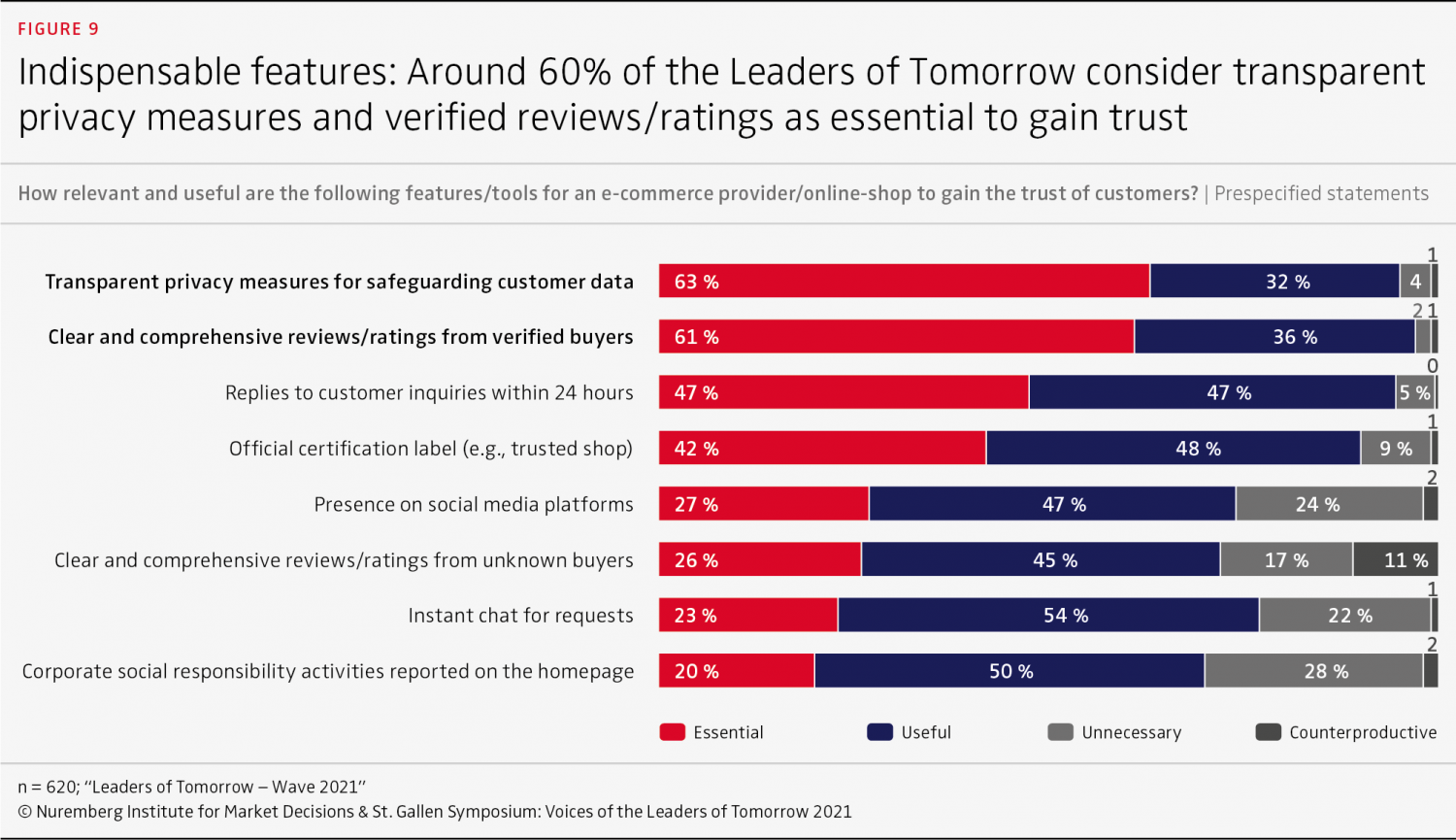
While this is clearly not a representative sample of online shoppers, it is interesting to learn what the Leaders of Tomorrow surveyed for this year’s Voices of the Leaders of Tomorrow Report – a collaboration of the Nuremberg Institute for Market Decisions (NIM) and the St. Gallen Symposium – think about this issue, as many of them are or will be running their own online businesses, which may lead them to particular judgemental scrutiny. Our results suggest that reviews and ratings are indeed considered particularly important (see Figure 9). This assess ment is in line with a statement from Giana M. Eckhardt (2020): “Hunting for ‘stars,’, the icons of the reputation economy, is a prerequisite for survival in e-commerce […].”
While none of the features listed in the survey are rated as dispensable or counterproductive for building trust by the majority of respondents, only two of them are rated as “essential” by around 60%. For example, besides “Transparent privacy measures for safeguarding customer data,” “Clear and comprehensive reviews/ratings from verified buyers” should not be missing in any online store. Two other factors are rated as essential by between 40% and 50% of the respondents: “Replies to customer inquiries within 24 hours (or even faster)” and “Official certification label (e.g., trusted shop).” All other features are assessed as being less essential for building trust (below 30%). This message is important because maintaining any service, of course, means additional effort and costs for the provider, and if resources are tight, focusing on the four main factors may help.
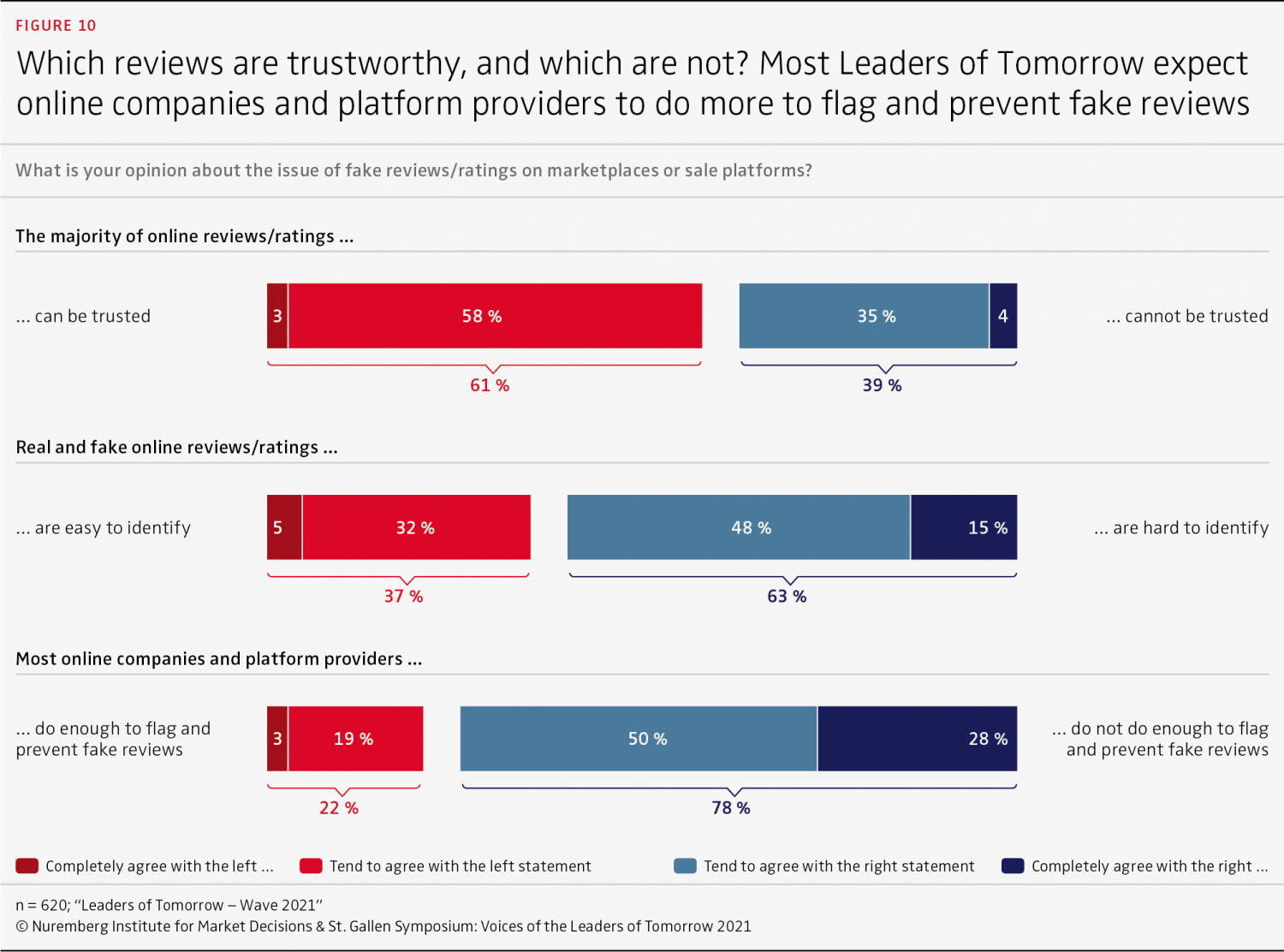
The majority of the Leaders of Tomorrow (61%) consider the reviews and ratings on online portals to be trustworthy, but the other 39% believe the opposite. Apparently, the reliability of reviews is a polarizing matter. No wonder, since most also believe that it is difficult to discern between genuine and fake ratings or reviews. The proportion of those who think they can easily identify fakes is significantly higher among those who say the reviews can be trusted (46%) than among those who say they cannot be trusted (23%). Respondents are relatively unanimous on the question of whether companies and platform providers do enough to identify fake ratings or prevent them altogether: They don’t, according to just under 80%. So there is still room for improvement when it comes to living up to expectations.
According to a Forbes article, a quarter of a company’s market value can be directly related to its reputation, and 87% of executives think that reputational challenges are more important than other strategic risks (Blanchard, 2019). Branding experts Susan Fournier and Shuba Srinivasan wrote: “Of all the assets under marketing control, brands are perhaps the most valued. A strong brand attracts new customers, retains existing customers and offers a platform for the introduction of new products. A strong brand can reduce risk by encouraging broader stock ownership, insulating a company from market downturns, granting protection from product failures and reducing variability and volatility in future cash flows” (Fournier & Srinivasan, 2018).
Therefore, a well-known brand with a good reputation seems to be very important for companies and a relevant trust factor for customers’ purchase decisions – at least in the offline world. Do the same rules apply in the online world, where many different products are available and easily comparable (in price) at any time? How do the Leaders of Tomorrow rate the importance of positive brand recognition in the online world compared to the offline world?
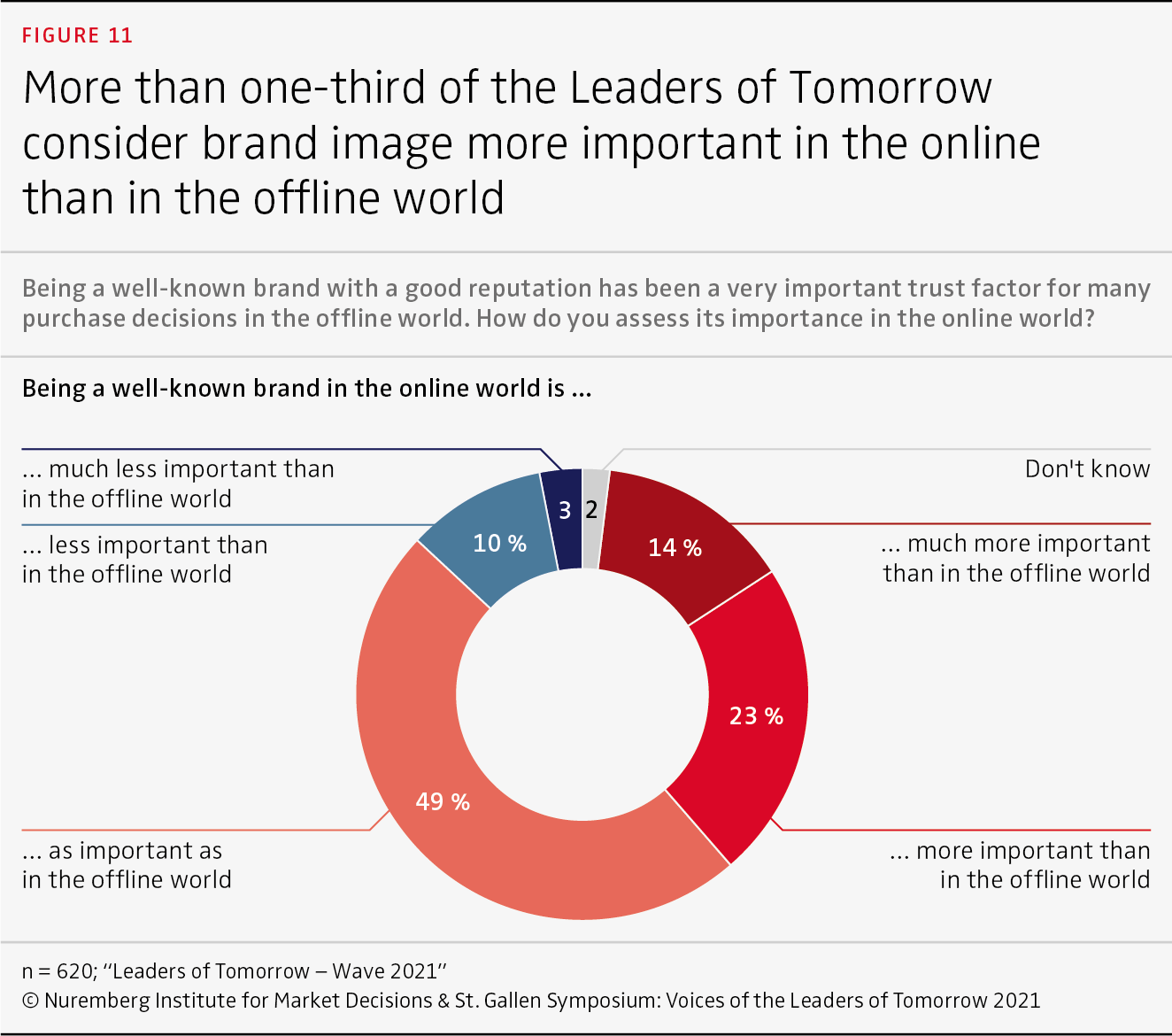
The largest proportion, almost half of the respondents, see no difference between the relevance of a good brand reputation in the online versus the offline world. This message alone should put marketing managers in a good mood. After all, in the early days of e-commerce, there were speculations, rumors and discussions on whether brands were doomed in view of the new transparency – especially of prices – on the internet. But the Leaders of Tomorrow’s message gets even more positive: While only 13% of the survey participants believe that the importance of a strong brand is less than in the offline world, significantly more see it exactly the opposite way. A total of 37% believe that brand reputation is even more important in the online world than in the offline domain. However, this does not mean that it will become easier to build and maintain a good brand image. The challenges for a successful brand presence on the internet may become even more diverse and greater than they are today.
Read the full Voices of the Leaders of Tomorrow Report here for all findings and detailed analysis.