10 Break-Out Sessions
[timetable id="9" column_title="0" filter_visible="1" filter_multiple="1" event_box_time="0"]
[timetable id="9" column_title="0" filter_visible="1" filter_multiple="1" event_box_time="0"]

People have been making money by exploiting human emotions since the dawn of time, and loneliness is no exception.
The Industrial Revolution – which saw people leaving their families and farms to move to cities in search of greener pastures, created a whole new market niche, says Shivangi Singh, a Leader of Tomorrow at the 48th St. Gallen Symposium and Young India Fellow at Ashoka University. “Loneliness hit them, and nightclubs appeared in response to that,” she says. “When you spend ten to twelve hours at work, what do you do when you are bored?”
More than 200 years later, we’re still lonely – in fact, globalisation only seems to have made the problem worse. And there’s even evidence loneliness is a public health threat. A study in 2016 found loneliness meant a 29% increased risk of coronary heart disease and a 32% greater risk of having a stroke. “Loneliness is a public health concern,” says Daniel Sawyer, one of the top student competitors of this year’s St. Gallen Wings of Excellence Award and a bioengineering doctoral student at Caltech. In Japan, one of the world’s most rapidly ageing societies, entrepreneurs seem to be finding innovative, albeit controversial, ways of providing companionship for their “kozoku” – loosely translated, the tribe of lonely people. Their solution: AI.
This year, Sony re-released their extremely popular companion-bot Aibo – first put on the market 20 years ago, then discontinued. “Sony was once really sensitive to how people can attach emotions to robotics,” says Hiroaki Kitano, the CEO of Sony Computer Laboratories and Aibo’s creator.
Aibo’s initial reception astounded the company, and Kitano himself. “People were very much more attached than we expected. It was overwhelming,” says Kitano. “That became a problem when we
discontinued it. People were very upset.”
But is it only the lonely who seek out companion-bots? “There are people who would not be able to have a real dog for a range of reasons, but still wish to have companions at home,” Kitano says. “We started thinking could we use it for therapy, for nursing homes, for these people and their emotional involvement.”
Two decades on, Kitano is far more skeptical when it comes to companion-bots as the remedy to the epidemic of loneliness, “Frankly, I do not think AI could necessarily solve the problem,” he says. “A robot may be able to assist humans, or temporarily play some role in interpersonal relationships, but it will not solve the problems behind it.”
AI to facilitate conversation? Sounds like something Daniel Sawyer might have pitched. His idea – to create a device that reads and translates empathy between two people – sparked a lot of conversation, even if the technology doesn’t exist (yet).
Such a device could help the lonely. “It is hard to prescribe someone friends,” Sawyer says. “Research on loneliness shows it can be about misinterpretation of social cues.” So if we had something to prevent this misinterpretation, quite possibly, we would not be as lonely?
But are we not really just missing the point of it all? Loneliness is a social issue, as well as a medical one. Do we not need contact with people, rather than machines? And is it dangerous to replace human relationships with robotic ones? Singh fears a reliance on robotics for emotional support would lead to people “losing their social skills,” skills which are “very essential to long term human survival.”
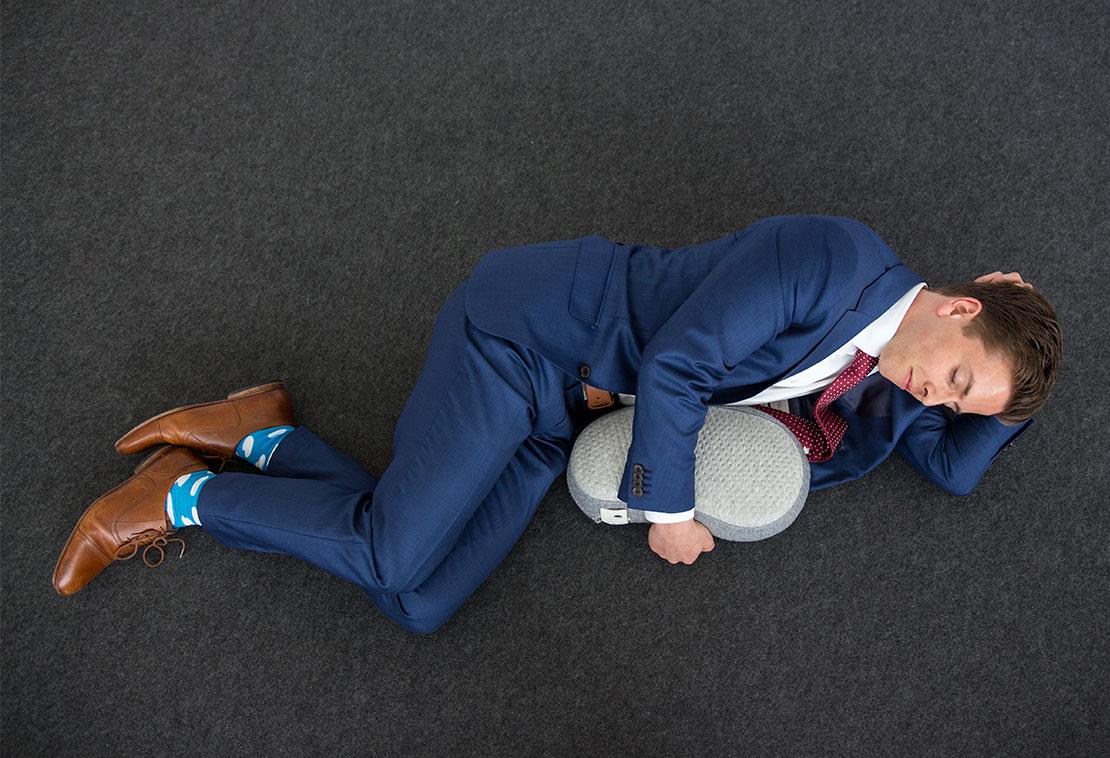
Techno-optimists think such concerns are overblown. Dutch inventor Stijn Antonisse, the creator of “Sonax,” a huggable robot the inventor claims helps you sleep, thinks that we now have the ability to give lonely people some immediate help in the form of robotics. So “why not?” he asks.
Leader of Tomorrow Vu Huynh believes we are looking at robots the wrong way. “We do not have to give them a human identity,” she says. “We know we have a smart TV, a smart fridge, and now we have a robot.” If we do not conceptualise the robot as a person, then fears of robots replacing human relationships become less dramatic. After all, have you not been ignoring your friends’ Thursday night dinner invitations in favour of your favourite TV show for years?
So: If you cannot sleep, you can hug a robot with a mechanical beating heart inside. If you are lonely, you can pet your Aibo. And if you cannot prescribe someone friends, is giving them a companion-bot really all that bad?
Whatever the answers are, discussing possible fixes for this epidemic of loneliness – either through the human touch, medicalisation or a furless dog-bot – at least shows we are taking this public health concern as seriously as we should.