10 Break-Out Sessions
[timetable id="9" column_title="0" filter_visible="1" filter_multiple="1" event_box_time="0"]
[timetable id="9" column_title="0" filter_visible="1" filter_multiple="1" event_box_time="0"]


The Re:Generation Lab, launched in 2022 as part of the St. Gallen Symposium’s “New Generational Contract” with the Club of Rome, is a core element of the annual programme, co-creating solutions to key intergenerational equity challenges such as intergenerational leadership, future thinking, and sustainability + innovation.
By Dr. Anna Brzykcy, Dr. Nora Keller, & Prof. Dr. Gudrun Sander
As part of the Re:Generation Lab at the 54th St. Gallen Symposium, the Competence Centre for Diversity, Disability and Inclusion of the University of St. Gallen and Merck Switzerland hosted a co-creation session on the fertility gap. Leaders of Today and Tomorrow looked at how low fertility awareness, stigma, and policy blind spots contribute to a growing imbalance from an affected individual perspective—and on what employers and policymakers can do to close the gap.
Career advancement and family planning remain a binary choice for many—especially women. In Switzerland, the anticipation that pregnancy will harm career prospects leads many to delay parenthood, often increasing the risk of age-related infertility. As life expectancy and professional timelines shift, fertility has become not only a medical and personal issue, but an urgent societal and economic one.
Did you know that…
… 20% of the Swiss population experiences or will experience infertility problems in their lifetime?
… 50% of men and women want to have two children, but only 38% actually have two children?
… over 50% of Gen Z and Millennials know little to nothing about factors influencing their own fertility?
… in vitro fertilisation (IVF) is not a quick fix and that only 1/3 of women who undergo this treatment end up delivering a baby?
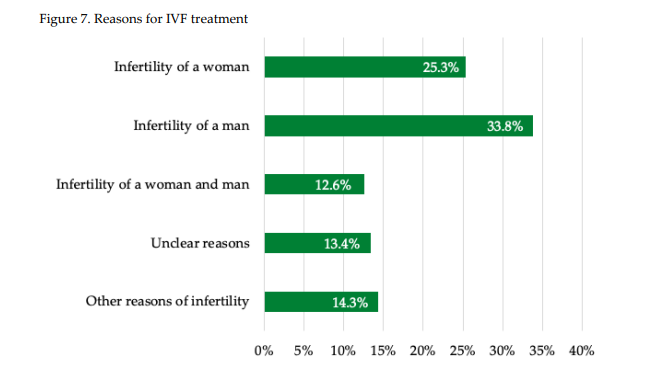
… men‘s infertility is more often the reason for IVF treatment than women‘s infertility?
… 44% of all promotions go to employees aged 31-40? That is, during the family prime time. With women still taking on a huge amount of care work, it is not surprising that 2/3 of senior management positions in this age group go to men.
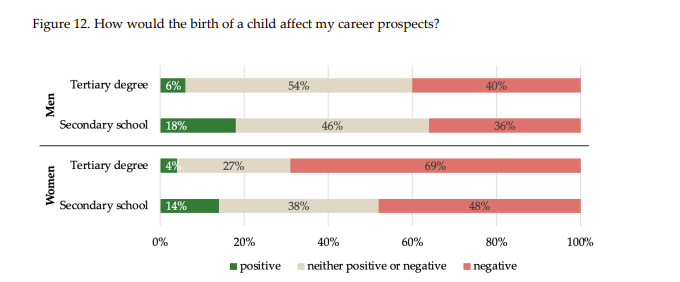
…69% of women with a tertiary degree expect pregnancy to have a negative impact on their career prospects.
… singles and male couples cannot access fertility treatments in Switzerland?
… Switzerland is the only country in Western Europe where no percentage IVF or intracytoplasmic sperm injection (ICSI) is covered by insurance or public funding? This means that the costs of fertility treatments have to be covered privately and can amount to over 50% of annual income.
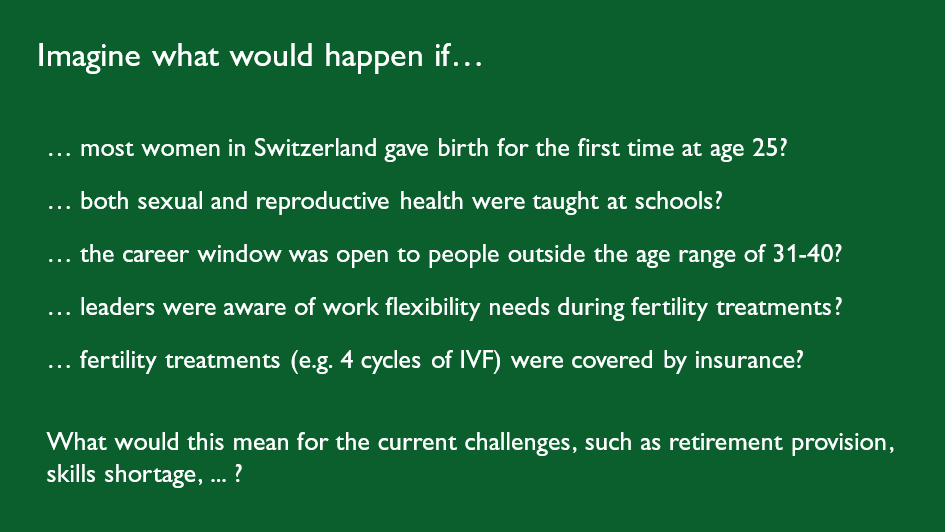
If generational equity is the foundation for future-fit leadership, then fertility policy must become part of the conversation. A system that discourages family formation—through financial barriers, institutional silence, or career penalties—harms not just individuals, but the workforce and society as a whole. Forward-looking leadership includes enabling people to lead full lives, across all life stages.
Download our white paper on fertility and family planning:
English: Read and download “If only I knew: Fertility policy and family planning in Switzerland” here
Dr. Anna Brzykcy, Dr. Nora Keller, & Prof. Dr. Gudrun Sander