10 Break-Out Sessions
[timetable id="9" column_title="0" filter_visible="1" filter_multiple="1" event_box_time="0"]
[timetable id="9" column_title="0" filter_visible="1" filter_multiple="1" event_box_time="0"]


In a hyper-VUCA world, successful leaders and leverage internal strengths and external resources to create a new kind of advantage. By building open ecosystems and fostering flexible collaborations, they create superior value propositions, dominate new markets, and drive innovation through connectivity.
Confronted with a world that is hyper volatile, uncertain, complex and ambiguous (VUCA), many managers chase after external changes: Racing after market trends in the latest industry reports, conducting risk assessments, and discussing the game-changing potential of generative AI in the board.
The best entrepreneurs – people who thrive in hyper-VUCA environments – are deeply sceptical of these attempts at strategic foresight: Nobody knows how AI will transform the competitive landscape yet. Instead of chasing after external trends and trying to predict scenarios, they shift the focus to their own strengths and capabilities. The good news is that the answers where to steer your company are already there – but not in analyses of external trends, but in your own employees, your customers and the partners in your ecosystem. Through these crucial resources, you can shape the future instead of chasing after it. After all, the best way to predict the future is to create it.
Louis Gerstner reinvented IBM through a crowdsourcing effort to which over 300’000 employees contributed. Satya Nadella managed one the most remarkable transformations of the 21st century by turning Microsoft from a monopolist to an open, collaborative company orchestrating partner resources throughout its entire ecosystem. Manufacturers such as P&G replaced their traditional research & development with a collaborative connect & develop department. Cisco out-innovated the much more prestigious and better resourced Bell Labs through an open approach based on collaborations and acquisitions.
This new approach goes beyond the traditional idea of competitive advantage. For decades, managers were taught based on Michael Porter’s classical framework: Competitive advantage was the result of superior positioning in the competitive landscape. By analysing and predicting the external world, managers were to find the optimal niche where their company could capture outsized value.
The problem with this approach in a hyper-VUCA world, of course, is that the world changes too quickly and too unpredictably: No positioning in the external world is a sustainable source of competitive advantage. Instead, exceptional leaders and organizations are increasingly going new ways: Instead of analysing their competition, they focus on their own capabilities. Instead of predicting the future, they create it. Instead of building barriers to entry, they build an open ecosystem by leveraging resources around them. Instead of winning through competitive advantage, they win through the adaptability and speed they achieve through collaborative advantage. What do we mean by collaborative advantage? In contrast to prior usage of the word, we loosely define collaborative advantage as the capability of an organisation to leverage resources inside and outside of its formal boundaries to create and capture value.
In today’s world, openness and connectivity are the keys to success. Ecosystems and open networks are the source of competitive advantage. We call this ‘collaborative advantage’ as companies focus on their strengths and partner together in order to create superior, innovative value propositions for their customers and dominate new uncontested market spaces. These companies create win-win-win situations for their customers, their partners, their employees and in the end their shareholders. They innovate by making the world their lab, instead of making the lab their world.
The insight that successful innovation and transformation is done not through heroic foresight but collaboratively with customers, partners and employees throughout the hierarchy was explored across various sectors and issue areas at the 51st St. Gallen Symposium in 2022. During our talks, exceptional leaders such as Roshni Nadar (Chairperson HCLTech, Forbes “100 most powerful women in business”), Manuel Barroso (President European Commission, 2004-2014) or Aditya Ghosh (President IndiGo, 2008-2018) highlighted how they have achieved their successes by nurturing open networks of flexible collaboration.
How can you lead for collaborative advantage? Research has shown that in most organisations only 4% of leaders are responsible for creating over 30% of the value-creating collaborations. To be clear, this is not a story of ineffective leadership. Rather, many managers are stuck in old mental models which are effective at managing processes and individuals, but don’t translate well to managing open, collaborative networks. But advantage moved from economies of scale (“the large eats the small”) over individual innovativeness (“the fast eats the slow”) towards collaborative advantage based on managing relations of synergy and coopetition (“the connected eats the lonesome”). These often coopetive relations form the “neural network” within and beyond your organization which drive innovation and transformation. They energise performance, guide or obstruct change and form the nervous system of an organisation through which ideas and resources can flow. A breadth of research in diverse contexts shows that the quality of these collaboration patterns of a group are much more important for its innovative performance than the individual skills and motivations of the group members. In addition, transformation initiatives which target collaboration signatures are typically between 4 and 8 times more effective than those which focus on individual employees.
What is needed is a new, complementary perspective to classical leadership principles. Both transactional and transformational leadership have their role in effective organisations, but organizations don’t succeed based on incentives and purpose alone. At the end of the day, humans are social animals. Effective leaders integrate collaborative leadership into their repertoire:
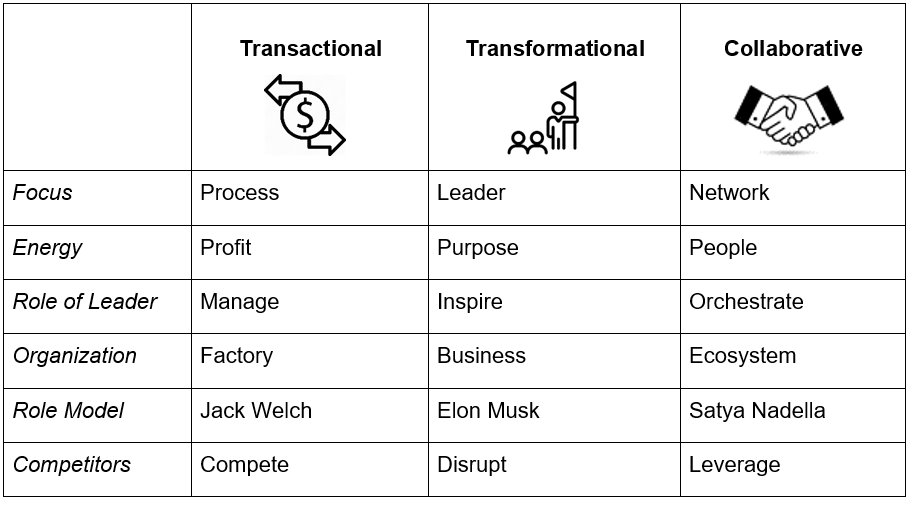
Table: Collaborative advantage requires a collaborative approach to leadership.
How can you put this into practice and start leading more collaboratively in your own organisation?
A good first step is to start small and create visibility around the openness of your organisation with regards to a key stakeholder. We recommend starting with customer-openness, as this is usually well accepted in most organisations. For example, you could consider taking a page out of tool manufacturer Hilti’s playbook and track throughout your organisation (i) how many direct customer interactions you have and (ii) what percentage of employees have a direct customer interaction at least once a week. Just by making these measures visible you send a strong signal throughout the organisation that you value openness with regards to the customer.
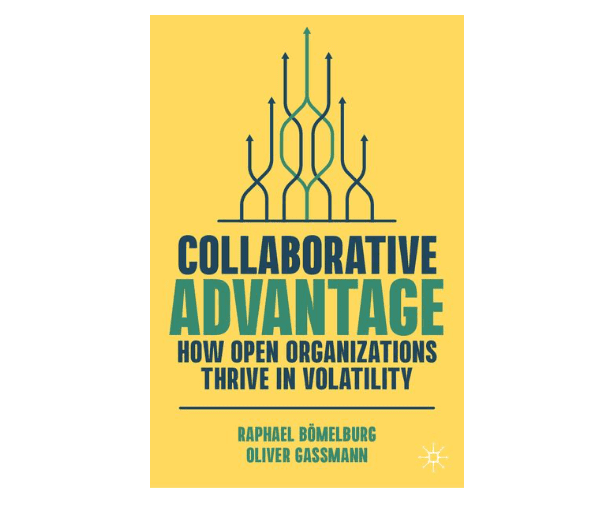
Interested in opening up your organisation? In their new book “Collaborative Advantage”, Raphael Boemelburg and Oliver Gassmann offer a wide range of practical cases and personal reflections from exceptional leaders such as Satya Nadella (CEO Microsoft), John Hennessey (Chairperson Alphabet), Roshni Nadar (Chairperson HCLTech), Matthias Doepfner (CEO Springer), Yves Daccord (Director General ICRC), and many others. It also explores how companies can use data and AI to better manage transformations: As knowledge workers use ever more software tools, they leave digital footprints which form an untapped treasure trove for people analytics. The book illustrates with a diverse set of concrete examples how these data sources can be interpreted and used in practice to drive transformative business value.
Oliver Gassmann, Raphael Boemelburg