10 Break-Out Sessions
[timetable id="9" column_title="0" filter_visible="1" filter_multiple="1" event_box_time="0"]
We look back on a programme featuring inspiring discussions, diverse perspectives and global leaders from across business, politics, academia and civil society.


At the Dinner for Partners, Ivan Krastev will engage with Ali Aslan in a one-on-one conversation on the state of the world, offering his perspective on current global developments and the challenges shaping today’s political and societal landscape.
Welcome to the 55th St. Gallen Symposium. This year’s Opening Ceremony sets the stage for a vital cross-generational dialogue on «Disrupted Age». We find ourselves in a time where technological breakthroughs, geopolitical tensions, and societal transformations are reshaping the foundations of our world. Established systems are being challenged, while new paradigms are rapidly emerging. As disruption becomes the defining feature of our era, the question is no longer whether change will occur, but how we choose to respond to it. As we begin this dialogue, we extend our sincere gratitude to all of you for joining us. Over the coming days, we look forward to engaging in open and constructive discussions, bridging perspectives across generations, and exploring how disruption can become a catalyst for meaningful progress.
Liberal democracy is increasingly being challenged—from technologists, political theorists, and populist thinkers alike. In this Oxford-style debate, political theorist Ivan Krastev and blogger Curtis Yarvin confront a provocative question: is the future of the United States and liberal democracies one of renewal—or replacement? Yarvin argues that democracy is structurally ill-equipped to address today’s complex governance challenges and instead advocates for radically centralized models of governance—envisioning the state run more like a corporation, led by a “CEO-in-chief” with executive authority to act decisively and efficiently. Krastev counters that, despite current pressures, liberal democracies remain resilient due to their capacity for adaptation, self-correction, and pluralism—and should be renewed rather than replaced. By confronting opposing visions of governance, the discussion challenges core assumptions about legitimacy, sovereignty, and the political future of the West—leaving the audience to decide not only what system works, but what kind of system they are willing to defend.
Political polarisation, rising inequality, and eroding trust in institutions are challenging both the effectiveness and legitimacy of democratic capitalism. As governments, markets, and citizens struggle to adapt, the challenge is no longer just how to achieve growth, but how to restore purpose, trust, and moral coherence in public life. How can economies balance innovation with social and ethical resilience? And what role should leadership, character, and values play in navigating the turbulence of a disrupted age?
Media is no longer just a channel for information, it has become a central arena where narratives are shaped, contested, and amplified. As traditional journalism faces declining trust and fragmented audiences, new voices, from influencers to independent creators, are increasingly influencing how stories are told and perceived. At the same time, political actors operate in a media landscape no longer defined by a few gatekeepers, but by a fast-moving and decentralised flow of information. The power to shape public discourse is becoming more distributed, and more contested. Bringing together perspectives from politics, traditional media, and new media, this session explores who shapes narratives today, and how power over public perception is evolving.
The United States remains the world's most influential power — yet its capacity to act decisively is increasingly constrained. Polarisation, institutional gridlock, and shifting political incentives are reshaping how power is exercised in Washington. Taking stock of the state of American power requires examining governance structures, institutional balance, and political decision-making. Against the backdrop of the midterm elections, the key question is whether the U.S. system can still convert power into strategic direction — and what this implies for America's domestic agenda and its role on the global stage.
Cultural heritage is increasingly shaped by the interplay between physical preservation and digital access. As vast amounts of knowledge, archives, and artefacts are created, shared, and stored online, the question of how to safeguard humanity’s collective memory has taken on new urgency. From digitising historical records to protecting cultural sites on the ground, institutions are navigating a rapidly evolving landscape marked by technological change, geopolitical tensions, and shifting norms around access and ownership. Ensuring that culture remains both preserved and accessible requires new forms of collaboration between public institutions, global organisations, and digital platforms. Bringing together perspectives from global cultural stewardship and digital archiving, this session explores how culture can be protected across both physical and digital realms, and how efforts today can ensure its resilience for future generations.
As traditional alliances fracture in the light of shifting global powers, the global humanitarian aid system is coming under strain. The United States is scaling back foreign assistance through cuts at USAID, while many governments are redirecting resources toward security and economic stability—even as humanitarian crises multiply. The result is a widening gap between rising needs and available support. Can private capital help close it? Recent collaboration between a philanthropic foundation and a frontline humanitarian organization in Sudan offers insight into both the potential and the limits of private engagement in crisis response. What can such partnerships realistically achieve—and how might philanthropy and business help sustain human dignity in a disrupted world?
Europe’s competitive edge is shrinking as growth slows and innovation stalls, with Germany’s automotive and traditional industries emblematic of a continent too focused on preserving past successes. While global rivals invest heavily in new technologies, Europe risks falling behind by trying to revive outdated models rather than embracing the next wave of industrial transformation. This session, which is co-hosted by HSG Alumni (the Alumni network of the University of St.Gallen), explores the structural roots of Europe’s decline, the consequences of nostalgia-driven policy, and the choices needed to regain momentum in a rapidly shifting technological landscape.
Global supply chains and business ties that have long contributed to rising prosperity are being weaponized as rivals seize key choke points, forcing leaders to rethink how they approach international opportunities and risks. Considering the latest developments from the Hormuz Strait blockage to tariff hikes, this panel will bring together perspectives from business, shipping, aviation, law, and economics to explore how geopolitical competition and conflicts are changing global business and what leaders in companies, governments, and other institutions can do to support a more resilient, prosperous, and sustainable future.
In collaboration with the Executive School of the University of St. Gallen, we examine how organisations can manage external disruption while sustaining performance, capability, and workforce resilience. Demographic, technological, and societal shifts are redefining competitive strategy, organisational capabilities, and workforce dynamics. Navigating these forces requires both strategic foresight and internal resilience across leadership, culture, and skills. This roundtable aims to explore how organisations can translate external complexity into sustainable performance and workforce stability.
Time to recharge — intellectually and nutritionally. Grab lunch and continue the cross-generational exchange.
Trade barriers, geopolitical fragmentation, technological acceleration, and demographic change are redefining the conditions under which global companies operate. For organisations built on scale, stability, and longevity, the challenge is no longer incremental adaptation—but fundamental transformation. This one-on-one conversation with Philipp Navratil focuses on how a truly global Swiss company navigates what many describe as a “Disrupted Age.” The discussion will explore how Nestlé responds to economic and geopolitical uncertainty, manages shifting trade regimes, embraces technological change, and adapts to evolving expectations from both its workforce and consumers.
(Session held in German & English) Have you ever found yourself in a LIVE SWISS TELEVISION (SRF) RECORDING with two of Europe’s sharpest minds debating the future of liberal democracy? No? Here’s your chance. Join a special edition of a live recording of Sternstunde Philosophie featuring Paul Morland and Barbara Bleisch, as they take on the question of whether migration can sustain solidarity in ageing societies without undermining social cohesion. The conversation will move between German and English, so a working understanding of both will definitely help you keep up. One more thing: this isn’t just a session – it’s a live video recording, so special requirements apply. By attending, you’ll be part of the audience on screen. To ensure the best visual quality, please avoid wearing checked patterns. For technical broadcasting reasons, Schweizer Radio und Fernsehen (SRF) kindly asks the audience to hand in jackets, coats, and larger bags (A4 size or bigger) before the session (storage space will be available on site). Additionally, the use of mobile phones is not permitted during the session.
In a time when fresh ideas and bold visions are urgently needed, we begin with a conversation with former International Student’s Committee (ISC) member Philipp Navratil, reflecting on his journey within the ISC and his perspective on the role of young leaders today. This is followed by the Global Essay Competition Award Ceremony. Bringing together outstanding Master’s and PhD students from around the world, the competition invites the 100 most promising participants to St. Gallen. From this group, the top three finalists present their ideas on how to shape the future. The session concludes with an interactive Q&A, offering the opportunity to engage directly with the authors and explore their perspectives in greater depth, before celebrating the winning essay.
Where should capital flow in a disrupted age to generate returns while addressing society’s most pressing challenges? Investors increasingly need to balance performance with long-term resilience, directing capital toward the sectors that will define economic and social stability. Renewing critical infrastructure, accelerating the energy transition, and scaling future technologies such as AI, semiconductors, and biotech are emerging as priority fields. At the same time, long-horizon investors — especially pension funds — play a pivotal role in enabling these transformations. The core question is how Europe can channel capital into these strategic areas to strengthen competitiveness, enhance societal resilience, and remain an attractive destination for long-term investment.
Heads of state and government increasingly look to historical figures of strong, often authoritarian leadership as points of reference, placing themselves more visibly at the center of political decision-making. The German philosopher and writer Peter Sloterdijk is one of the most influential thinkers in contemporary European thought. In his latest work, The Prince and His Heirs, he examines the figure of the modern “prince”: powerful leaders who personalize authority, deploy charisma strategically, and visibly embody political power. What does the return of such personalities reveal about the state of our societies? Are we entering a new phase of personalized power — and what responsibility rests with those who exercise it?
As societies across the world face aging populations and growing labour shortages, pressure on essential services is increasing. At the same time, advances in robotics are expanding what is possible, from supporting care environments to taking on physically demanding and hazardous tasks in sectors such as construction. The integration of robotics into these contexts raises complex technical, societal, and ethical questions, as organisations work to ensure safe and human-centric deployment. Bringing together entrepreneurial perspectives from different sectors, this session offers a grounded look at how robotics is already being applied in practice and how technology and human work can evolve together to address workforce gaps while improving safety and quality of life.
China is entering a pivotal phase as it recalibrates its growth model and doubles down on AI and advanced industries, while navigating mounting economic and geopolitical pressures, including challenges such as involution. At the same time, the evolution of its financial system and capital markets is becoming a critical lever in supporting this transformation and shaping broader global economic dynamics. As Beijing seeks to balance growth, stability, and an increasingly assertive global posture, the key question is not only how China will integrate AI and disruptive technologies into its ecosystems, but also how financial structures and capital allocation will underpin this shift. For Europe, this moment presents both risks and opportunities. If China is redefining the dynamics of competition and technology, how can the EU position itself to benefit rather than be sidelined?
In a disrupted age defined by climate urgency and rapid advances in artificial intelligence, a new challenge is emerging at the heart of the energy transition: aligning the growth of AI with planetary limits. As data centres expand and compute demand accelerates, AI is becoming one of the fastest-growing drivers of global energy consumption. This raises a critical question: can we scale intelligence without scaling emissions? This session brings together leaders from policy, industry, and innovation to explore whether rising AI-driven energy demand can be met in ways that are both efficient and sustainable. Which technologies - from low-carbon energy systems to more efficient hardware and software - can reduce the energy footprint of AI? And where are current approaches falling short?
(Session held in German & English) Have you ever found yourself in a LIVE SWISS TELEVISION (SRF) RECORDING with two of Europe’s sharpest minds debating the future of liberal democracy? No? Here’s your chance. Join a special edition of a live recording of Sternstunde Philosophie featuring Ivan Krastev and Wolfram Eilenberger, as they take on the big questions shaping liberal democracies today – and where they might be headed next. The conversation will move between German and English, so a working understanding of both will definitely help you keep up. One more thing: this isn’t just a session – it’s a live video recording, so special requirements apply. By attending, you’ll be part of the audience on screen. To ensure the best visual quality, please avoid wearing checked patterns. For technical broadcasting reasons, Schweizer Radio und Fernsehen (SRF) kindly asks the audience to hand in jackets, coats, and larger bags (A4 size or bigger) before the session (storage space will be available on site). Additionally, the use of mobile phones is not permitted during the session.
Most people walk past them without stopping. A Miró. A Calder. A Giacometti. Some of the most significant works of the 20th century, quietly living on the HSG campus. Take a short break from the program and join a small group for a guided art walk across the University of St.Gallen campus. We'll take a slow walk across campus - as each piece invites us to pause, look closely, and reflect on the disrupted age we have all been discussing. No art background needed. Just curiosity and comfortable shoes.
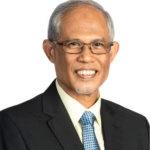
Social cohesion and family resilience are essential foundations for societal stability amid digital alienation, social isolation, and fragmented communities. Singapore, confronted with demographic shifts, develops family policies and social support networks under the leadership of Minister Masagos Zulkifli at the Ministry of Social and Family Development. Through initiatives that strengthen families, promote civic participation, expand community support structures, and improve social mobility, the government seeks to enhance resilience and strengthen social cohesion. By drawing on Singapore’s experience, Minister Masagos will discuss how state programs and family support can effectively sustain long-term social cohesion in a society that is both increasingly digital and undergoing profound demographic change.
Gesellschaften erleben seit einigen Jahren eine wachsende politische Polarisierung. Immer mehr (v.a. Junge) Menschen fühlen sich von der politischen Mitte entfremdet und orientieren sich an Positionen am rechten oder linken Rand. Vertrauensverlust in Politik, Medien und Institutionen, aber auch Identitätsfragen, Ängste und das Bedürfnis nach Zugehörigkeit prägen diese Entwicklungen. Ein interdisziplinärer Blick zeigt mögliche Ursachen – und Ansätze, wie gesellschaftliche Brüche überwunden werden könnten. Welche Mechanismen treiben Polarisierung wirklich voran? Und wie lassen sich neue Formen politischen Vertrauens aufbauen?
For decades, Europe’s digital landscape has relied heavily on technologies, platforms, and infrastructure developed beyond its borders. This openness has driven innovation, growth, and global connectivity — with companies and citizens benefiting greatly from the dynamism of international technology providers. As global competition intensifies and geopolitics become increasingly intertwined with technology, digital sovereignty has moved to the forefront. More than 90 major European companies have called for a “sovereign infrastructure fund” to strengthen Europe’s digital foundations and ensure long-term resilience — not in opposition to global partners, but alongside them. The strategic question is clear: how can Europe reconcile openness with autonomy, regulation with competitiveness, and global partnership with strategic independence?
As Europe confronts a rapidly deteriorating security environment, the continent is being forced to reckon with the return of hard power. Drone incursions into Polish airspace highlight how quickly crises can unfold and how exposed Europe's eastern flank remains. At the same time, governments across the continent are rearming at a pace unseen in decades, rebuilding industrial capacity, reassessing long-held strategic assumptions, and new NATO members add perspectives shaped by proximity to Russia and the demands of collective defence. The aim is to illuminate Europe's most acute pressure points and explore how political, military, and economic actors can strengthen the continent's resilience and deterrence — ensuring that stability is preserved and escalation on European soil is prevented.
Geopolitical turbulence, technological acceleration, and increasing regulatory divergence are challenging the foundations of global finance. For organisations built on trust, stability, and long-term capital stewardship, the question is no longer incremental adaptation — but how to transform fundamentally in a rapidly changing world. In this one-on-one discussion with Sergio P. Ermotti, Group CEO of UBS, we explore how the bank and the Swiss financial centre navigate current challenges and opportunities. The conversation will examine how Switzerland and UBS address technological innovation and shifting regulatory demands, and what is required to preserve Switzerland’s role as a trusted and influential player in the evolving global financial landscape.
Critical infrastructure has become the backbone of geopolitical power in a fragmented world. As technological disruption accelerates and geopolitical rivalry intensifies, infrastructure is no longer merely an economic asset — it has emerged as a strategic lever of sovereignty, resilience, and global influence. From energy grids and digital networks to supply chains and data systems, the foundations of modern societies are increasingly exposed to hybrid threats, technological dependencies, and geopolitical coercion. At the same time, advances in artificial intelligence and digitalization promise greater efficiency and resilience — while introducing new systemic risks. Against this backdrop, critical questions emerge: where do the greatest vulnerabilities lie — and what will it take to turn infrastructure from a point of fragility into a source of strategic advantage?
What does it look like when art disrupts? Come find out. The ISC Lounge will be transformed into an immersive space inspired by "The Art of Disruption," blending bold artistic expression with the kind of warm, intimate atmosphere that makes for truly memorable conversations. This year, we are proud to feature St. Gallen-based artist Roger Hotz, who has created an entirely new piece exclusively for the 55th St. Gallen Symposium. Be part of the live art reveal and experience the moment a new work enters the world. With panoramic views over St. Gallen from the terrace and a setting designed to spark curiosity, this gathering invites you to explore what it means to challenge conventions, reimagine boundaries, and find beauty in the unexpected. Connect with fellow guests, exchange perspectives, and let the art around you set the tone for an evening of inspiration and genuine connection. Whether you come for the atmosphere, the people, or the ideas, you are in for a night that stays with you. We are excited to welcome you!
Be one of the leaders to join our Flat Talks! Flat Talks are intimate dinner discussions between a handful of leaders and students, hosted across the city of St. Gallen by our very own students in their flats. This unique experience offers the opportunity to engage in meaningful conversations with bright young minds while experiencing the vibrancy of student life. Flat Talks provide a chance to relive your own student days, reconnect with the curiosity and energy of academic life, and share your experiences in a casual and inspiring setting. They serve as an alternative dinner format to Wednesday evening’s events, with transport options available to attend the Open House Night afterwards.
At this evening event marking the first 200 days of the Trade and Economic Partnership Agreement between the EFTA-states and India, participants gather to reflect, connect, and look ahead. Set in the context of a dedicated networking dinner, the session provides a platform to exchange perspectives on one of the most forward-looking trade agreements linking Europe and a rising global powerhouse. In an era of accelerating technological change, shifting trade dynamics, and geopolitical uncertainty, such partnerships are becoming essential. For globally connected economies like Switzerland, as well as for India’s continued rise, TEPA represents a strategic effort to combine market access with investment, innovation, and long-term growth. Bringing together key voices from both sides, this session explores early signals of impact and the pathways to translate ambition into tangible outcomes, while highlighting how collaboration today can lay the foundations for shared prosperity.
After a day filled with bold ideas, brilliant minds, and inspiring conversations, not to mention some seriously good food, we’re ending the day just like the best student memories: with good music, great company, and a celebration that carries into the night. Join us for an evening that blends the charm of classic student parties with the buzz of new connections and shared ideas. Whether you're catching up with familiar faces or toasting with newfound friends, this is your chance to unwind, dance a little (or a lot), and enjoy the lighter side of a day well spent. See you there!
In a time of deep uncertainty, governments and central banks must balance growth, price stability, and open and competitive economies. How can fiscal and monetary policies sustain resilience and competitiveness amid high interest rates, rising debt, and global fragmentation? At the same time, demographic change, technological disruption, and evolving labour markets are fundamentally reshaping both economic performance and social structures. How can societies adapt in ways that preserve opportunity, uphold meritocracy, and maintain trust across generations and communities? Bringing diverse national perspectives, this session explores how economic and social systems can reinforce each other - ensuring stability and competitiveness while strengthening public trust and enabling all individuals to thrive in a changing world.
In a world shaped by disruption, the role of the state is once again under scrutiny. Does economic success depend on lean, agile and independent governments that maximize market freedom—or on strong institutions and formal alliances that provide stability, coordination, and protection? As geopolitical fragmentation intensifies and economic pressures mount, this question has become a defining strategic choice. Bringing together Alejandro Cacace, a former "Leader of Tomorrow" of the St. Gallen Symposium, and Roxana Chirițoiu, one of this year’s St. Gallen Symposium "Leaders of Tomorrow" cohort, this session explores two contrasting governance models through a dynamic, moderated exchange. Drawing on their respective contexts and experiences, the discussion will unpack how different approaches to regulation, state capacity, and market design shape competitiveness and resilience. Placing these perspectives directly in the Hot Seat, the session creates a setting of focused confrontation and rapid exchange, where assumptions are tested and positions challenged in real time. It invites participants to critically reflect on the evolving balance between state and market—and what it ultimately takes for economies to remain adaptive, competitive, and future-ready in an increasingly multipolar world.
In today’s always-on world, our most valuable asset is attention. Constant connectivity and digital overstimulation disrupt our ability to focus, rest, and regenerate. This chronic cognitive overload not only increases stress, but over time can compromise brain health, affecting memory, decision-making, and potentially increasing the risk of conditions like dementia. Understanding how environmental and lifestyle factors, as well as mindful use of technology, influence mental resilience is critical. By combining emerging insights from neuroscience with AI-driven tools that track behavior and attention patterns, and practical strategies for managing cognitive load and recovery, we want to explore how we can safeguard cognitive capacity, support mental well-being, and build sustainable personal and organizational performance.
Biotech breakthroughs, cellular rejuvenation, and data-driven prevention are beginning to redefine the boundaries of human aging & could extend even beyond lifespan and healthspan. But how far can cellular reprogramming push the biological limits of aging? What happens with a society when preventive medicine becomes fully data-driven and predictive? & which technologies will truly scale from cutting-edge labs to everyday healthcare? Let‘s take a concise interdisciplinary look at the technologies poised to transform how long—and how well—we can live.
In the digital age, gaming communities can serve as important social arenas where young people connect. Many young gamers not only maintain friendships but also engage in discussions about civic and political that are further strengthened through in-person encounters, such as meetups or public events. These hybrid spaces illustrate how the next generation navigates both digital and physical environments, raising the question: What role do digital and analog spaces play in shaping the democratic habits of young people?
Artificial intelligence is moving beyond chatbots and digital assistants. What began with large language models is evolving into agentic systems and industrial AI- technologies that not only process information but increasingly shape the physical world. From engineering and manufacturing to logistics and infrastructure, AI is entering real-world systems. Companies are using it to simulate machines, optimise factories, and redesign complex processes—changing how products are designed, built, and operated. This shift raises fundamental questions for industry: What technologies are needed to bring AI into the real economy? And how will human expertise evolve as decision-making becomes increasingly embedded in intelligent systems?
Emerging technologies — including but not limited to artificial intelligence — are reshaping defense capabilities, intelligence operations, and the broader security environment. At the same time, nations, institutions, and societies are struggling to keep pace with the strategic, ethical, and security implications that accompany these shifts. The aim is to provide a clear-sighted assessment of the AI-driven developments in defense — and to explore how public & private actors can work together to prepare for the conflicts of the future in order to prevent them.
Capital is a powerful signal of what may shape the future. It flows toward the technologies, industries, and business models expected to define the next decade, from AI and advanced manufacturing to climate tech, biotech, and new forms of mobility. But capital does not move in isolation. As new sectors rise and others lose momentum, investors, business leaders, banks, and public markets are all forced to rethink how value is identified, financed, governed, and scaled. This session explores what changing capital flows reveal about the next wave of breakthrough industries and how private capital, financial institutions, and market leaders can respond to a rapidly shifting economic landscape.

In an ageing society, sustaining solidarity becomes as much a social challenge as an economic one. Currently, in OECD countries, there are approximately 33 individuals aged 65 and over for every 100 working-age adults, a ratio that is rising and thereby intensifying the economic and social burden on younger generations. Migration can help against this social burden and support welfare systems in ageing societies, but is simultaneously testing social cohesion and public trust. When newcomers enter already strained systems, tensions can arise over access to jobs, housing, and social benefits. This session explores how migration can be integrated into a renewed intergenerational contract that balances economic necessity with social stability, and asks where the limits of solidarity may lie.
How can companies ensure business continuity and remain competitive in a business environment increasingly shaped by geopolitical tension - as planning certainty becomes harder, and at times impossible, to achieve? Disruptions in the Middle East - from fragile supply chains to energy market volatility and bottlenecks in critical inputs - are adding new layers of risk and complexity. For companies, the challenge is to adapt investment and supply chain strategies to a landscape shaped not only by policy shifts, but also by structural dependencies and vulnerable trade routes. At its core, the key question is how firms can position themselves to remain resilient amid the Middle East conflict.
The 20th century was shaped by numerous narratives - ranging from progress, freedom, prosperity, and equality to ideological opposites like capitalism versus communism. Many of these narratives today feel exhausted, contested, or fragmented. Looking ahead, we lack a unifying global narrative - a shared framework that shapes our present and allows us to look forward with hope. A narrative that connects people across borders, inspires them, and motivates a critical engagement with the status quo while encouraging active participation in shaping the future. The roundtable is intended as a starting point: together with experts from diverse industries and regions, we aim to develop a comprehensive narrative that is both tangible and action-oriented. Over the course of a year, the vision of a “St. Gallen Narrative” will be refined, and concrete measures defined to ensure it can be effectively shared and implemented in the world.
As artificial intelligence reshapes the workplace, the decisive question is no longer whether organizations will adopt it, but how they will do so responsibly and well. This session brings together senior leaders and Leaders of Tomorrow to explore what meaningful human-centered AI adoption should look like in practice. What should AI enhance in people’s work, and what must remain firmly protected? Drawing on cross-generational insights from the 2026 Voices of the Leaders of Tomorrow report by NIM and the St. Gallen Symposium, the discussion will examine how organizations can use AI to strengthen judgment, learning and meaningful contribution while preserving trust, accountability and human agency. The Voices of the Leaders of Tomorrow (VOLOT) Report brings the perspectives of emerging leaders into strategic debates that matter for business. By comparing the views of Leaders of Tomorrow with those of senior executives, the report shows where expectations of future leaders align with current leadership thinking and where important tensions are already visible. The 2026 edition looks at one of the defining leadership questions of the coming decade: how AI should shape work, decision-making, and human capability. It asks not only what AI can do, but also what kind of organizations leaders want to build with it.
The competitiveness of Germany and Europe as an investment location increasingly depends on how effectively political frameworks and corporate strategies translate into action. Stable forward-looking regulation, targeted incentives, and efficient processes are essential — as is the willingness of businesses to commit capital, scale innovation, and invest for the long term. Alignment between policymakers and industry remains key — a tension explored through the perspectives of Oliver Blume, CEO of Volkswagen Group, and Martin Blessing, Germany’s Foreign Investment Commissioner.
The global order is marked by growing multipolarity, where the power of political cooperation increasingly intersects with the return of power politics. Europe, seeking to maintain security and uphold democratic principles while preserving a rules-based order through cooperation, faces persistent challenges. The United States continues to assert global influence, meanwhile, African nations such as Namibia are pursuing more autonomous strategies, using diversified partnerships to navigate great-power rivalries without losing agency. This session convenes voices from Europe, the United States, and Africa to examine how small states, rising actors, and superpowers navigate interdependence and rivalry, and to explore what effective cooperation can look like amid competing interests, shared challenges, and the need to reinforce a rules-based international order.
Political polarization, global crises, and social change are reshaping how generations relate to one another. At the same time, crossgenerational dialogue is becoming an increasingly important resource for social cohesion, democratic resilience, and conflict transformation. This session explores how meaningful dialogue between generations can be strengthened in times of conflict, what obstacles stand in the way, and which approaches show promise. Using a fishbowl format, panelists and participants will exchange perspectives, share experiences, and identify practical strategies for fostering crossgenerational understanding.
In his new book Epic Disruptions, Scott D. Anthony argues that transformative innovation follows recognizable patterns: it makes the complex simple, the scarce abundant, and the expensive accessible. Such disruptions not only reshape industries but reorder societies—altering how people work, coordinate, and trust. From the printing press to AI, these shifts expand human possibility while straining existing institutions and norms. Understanding the logic of disruption offers clues to the systems now under pressure and to the futures that may emerge from them.
Military escalation, proxy dynamics, and fragile diplomatic efforts are unfolding simultaneously across the Middle East in the context of the war involving Iran, underscoring the volatility of the current moment. Yet the implications extend far beyond the immediate conflict. How does the war with Tehran intersect with shifting regional alignments, evolving security concerns in the Gulf, and the broader risk of regional spillover? At the same time, the situation raises fundamental questions of international law. How are core principles—state sovereignty, the prohibition of the use of force, and the right to self-defense—being interpreted, and potentially stretched, in this context?
Breakthroughs in science and technology are rapidly reshaping what medicine can achieve: from transforming once fatal diseases into manageable conditions to enabling entirely new approaches to prevention, longevity, and personalized health. Advances in neuroscience, diagnostics, and AI-driven health technologies are shifting the focus of healthcare from treatment to early detection and true prevention, opening the door to longer and healthier lives. Yet scientific progress alone does not determine real-world impact. The key challenge lies in how innovation is enabled, how quickly it reaches patients, and who ultimately benefits. As regions compete for talent, investment, and leadership in medical innovation, policy decisions increasingly shape both access and societal value. At the same time, these developments raise profound ethical questions: How far should we go in extending life? How do we ensure equitable access? And how do we keep the human at the center of care? This session brings together leading experts to explore the next frontier of longevity and personalized health. We will examine the opportunities emerging from cutting-edge technologies, the responsibilities that come with them, and the choices societies must make as the boundaries of medicine and human lifespan continue to expand.

As Europe and the United States reassess and redefine their relationship, long-standing assumptions about open markets – and the trust underpinning transatlantic cooperation – are being tested. What does rising uncertainty around trade policy mean for global value chains, and how are these shifts reshaping political and strategic alignment, prompting Europe to strengthen its own capabilities and coordination – and potentially driving greater independence and cohesion among European countries? At the same time, Europe's perception of the United States is evolving: internal developments are becoming harder to interpret, long-held images are beginning to erode, and there is a growing recognition that the transatlantic relationship may not return to its previous form – raising questions not only for Europe, but also for the United States itself, from labor market dynamics to inflation and broader economic stability.
As we part ways, let us lead with the next generation in mind—especially in this Disrupted Age, where established systems are being challenged and redefined. In times of uncertainty and rapid change, the responsibility lies with us to turn disruption into opportunity: to foster collaboration across generations, bridge divides, and shape a future that is not only resilient, but inclusive and forward-looking.