10 Break-Out Sessions
[timetable id="9" column_title="0" filter_visible="1" filter_multiple="1" event_box_time="0"]
AI, talent, knowledge and mental health
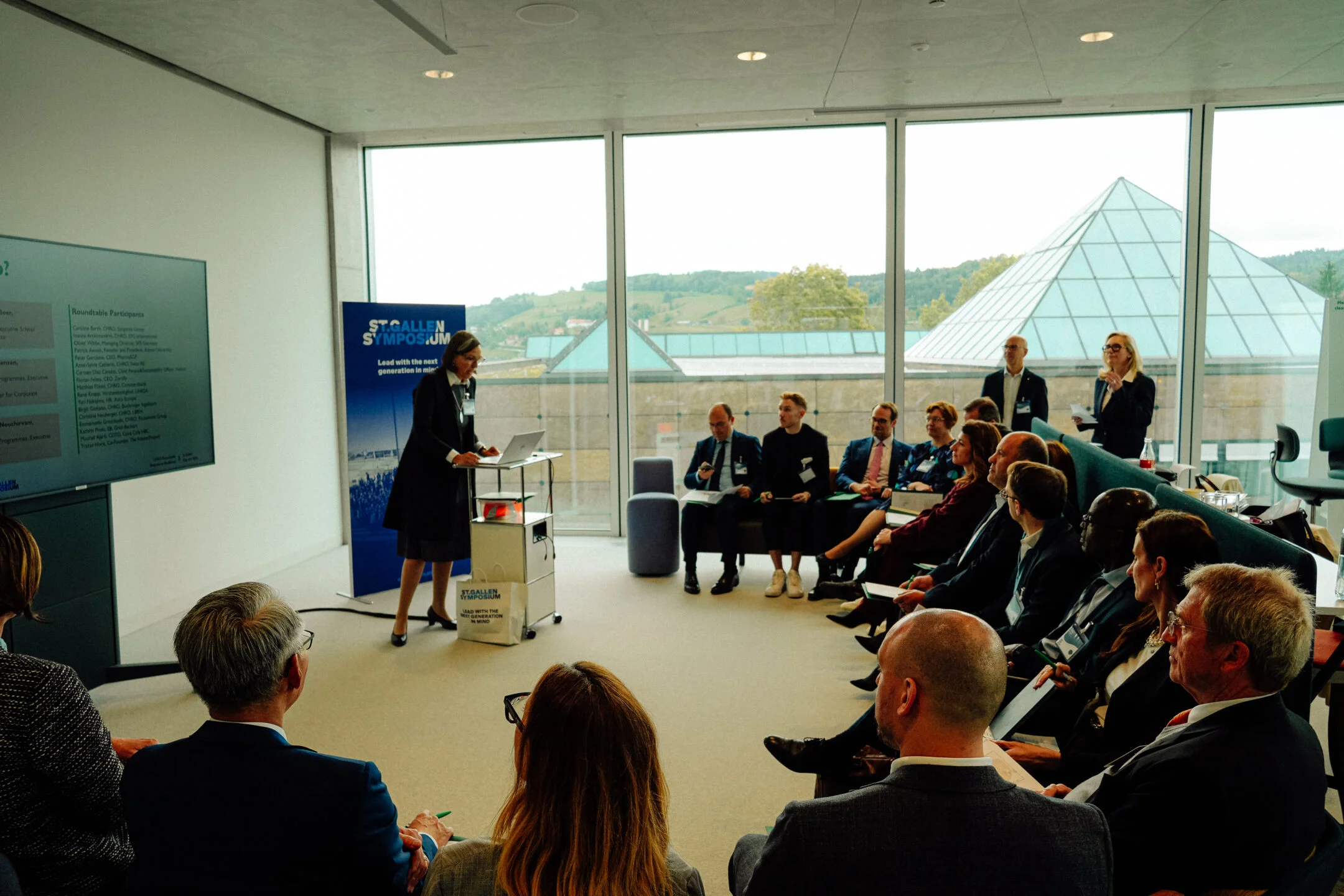
Workforce resilience is where Chief Human Resources Officers (CHRO) will win or lose the next decade. At the CHRO Roundtable of the 55th St. Gallen Symposium, senior HR leaders from multinational companies came together for a practitioner-driven exchange on AI, talent, institutional knowledge, and mental health – grounded in sharp hypotheses from leading researchers. The roundtable was jointly convened by the St. Gallen Symposium and the Executive School of the University of St.Gallen. In a facilitated conversation at three tables participants tested what these hypotheses mean for their day‑to‑day decisions in performance management, pipeline development and leadership responsibility.
The Roundtable was designed and facilitated by Dr Kiyan Nouchirvani (Executive Director Custom Programmes), Annette Collisy‑Lenzen (Director Custom Programmes) and Esther‑Mirjam de Boer (Head of Marketing, Executive School). Their brief: create a space where experienced CHROs openly share insights about what works, what does not – and what might need to change.
To sharpen the conversation, they drew on three hypotheses from Prof. Dr Antoinette Weibel (HRM, FAA‑HSG), Prof. Dr Falk Uebernickel (Innovation & Design Thinking, ZHAW and HSG) and Prof. Dr Stephan Alexander Böhm (Diversity Management & Leadership, IIDM‑HSG): that monetary incentives can undermine innovation, that firms are depleting their tacit‑knowledge capital faster than they renew it, and that the best antidote to the organisational mental‑health crisis is qualified leadership and genuine inclusion. These hypotheses served as a backbone.

For many participants, the value of the format lay in the combination of clear, research‑based hypotheses and a very concrete, practice‑oriented moderation. As one participant put it, it was “a great approach: starting from hypotheses, then working through very practical questions.”
The Executive School served as a senior sparring partner for the CHROs to rethink performance logic, knowledge pipelines and leadership responsibilities in the age of AI. By curating this kind of confidential, research‑informed practitioner dialogue, the Executive School helps organisations translate complex challenges into specific decisions.
For further information, please contact:
Dr Kiyan Nouchirvani MD, Executive Director Custom Programmes, [email protected]
Annette Collisy‑Lenzen, Director Custom Programmes, [email protected]
Esther-Mirjam de Boer, Head of Marketing, [email protected]


